#
CIP User Manual
Table of contents
Overview
yet to update
Civil Infrastructure Platform
The Civil Infrastructure Platform (“CIP”) is a collaborative, open source project hosted by the Linux Foundation. The CIP project is focused on establishing an open source “base layer” of industrial grade software to enable the use and implementation of software building blocks in civil infrastructure projects. Currently, civil infrastructure systems are built from the ground up, with little re- use of existing software building blocks.
Reference Hardware
The CIP project has selected a number of hardware platforms to be used as reference platforms for the project’s software.
Open Source Base Layer (OSBL)
OSBL is a set of industrial grade core open source software components, tools and methods. It is composed of the CIP kernel source code, and the CIP Core source packages.
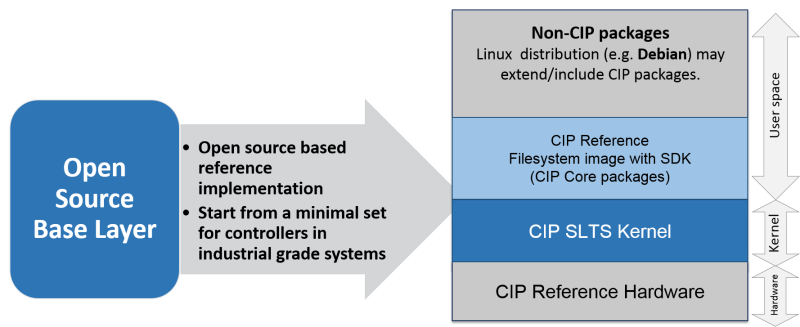
CIP Kernel
CIP supports and maintains the kernel for a long time (+10 years).
Currently supported CIP SLTS kernels
The current released CIP kernels are as follows.
Version |
Maintainer(s) |
First Release |
Projected EOL |
|---|---|---|---|
SLTS v4.19 |
Nobuhiro Iwamatsu & Pavel Machek |
2019-01-11 |
2029-01 |
SLTS v4.19-rt |
Pavel Machek |
2019-01-11 |
2029-01 |
SLTS v4.4 |
Nobuhiro Iwamatsu & Pavel Machek |
2017-01-17 |
2027-01 |
SLTS v4.4-rt |
Pavel Machek |
2017-11-16 |
2027-01 |
CIP core
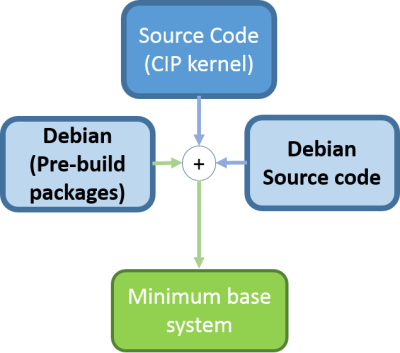
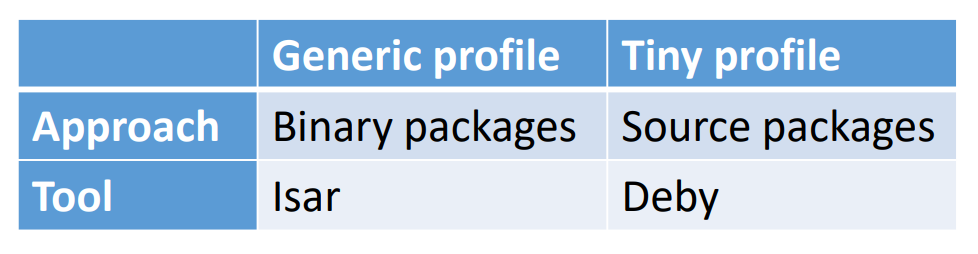
CIP core has two profiles:
The tiny profile is built from Debian source code and is useful for devices with storage restrictions, extreme performance and flexibility requirements, and low-complexity applications.
The generic profile is built from Debian binary packages and covers devices that require more functionality, have less performance and flexibility requirements, and more storage.
Tiny profile(Deby)
Deby is built with poky and meta-debian, a layer for the poky build system that allows cross-building file system images from Debian source packages. Deby does not use Yocto/OE source code.
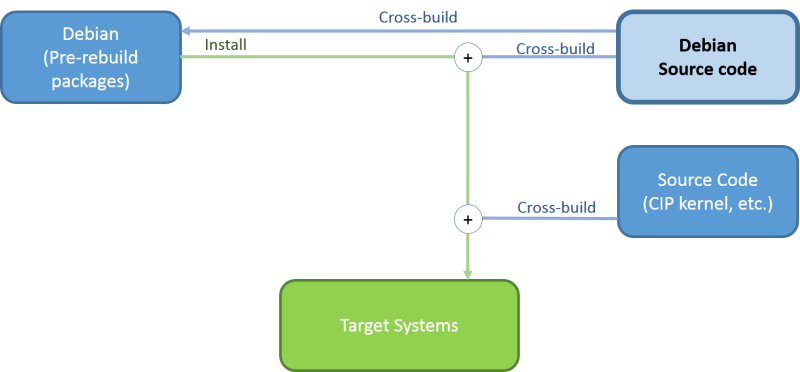
Refer Deby CIP source repository at https://gitlab.com/cip-project/cip-core/deby
Generic Profile (isar-cip-core)
ISAR uses bitbake to generate the file system image by reusing Debian binaries and rebuilding packages that need modifications for the target board.
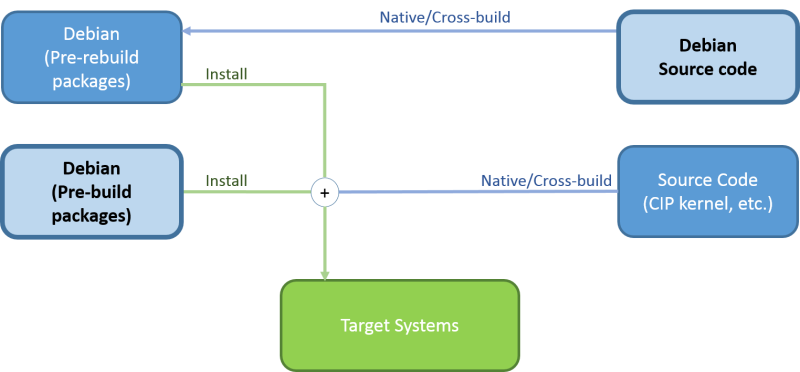
Refer ISAR CIP source repository at https://gitlab.com/cip-project/cip-core/isar-cip-core
Package list
The list of CIP Core packages and the process to add or remove packages is described here.
How to Create CIP Images
ISAR CIP Core
Deby CIP Core
Default User Accounts
Default user account is root.
Porting CIP for New Hardware
TBD
CIP Testing
CIP uses B@D (Board at Desk) to run automated testing on local Beaglebone Black or Renesas RZ/G1M iwg20m platform.
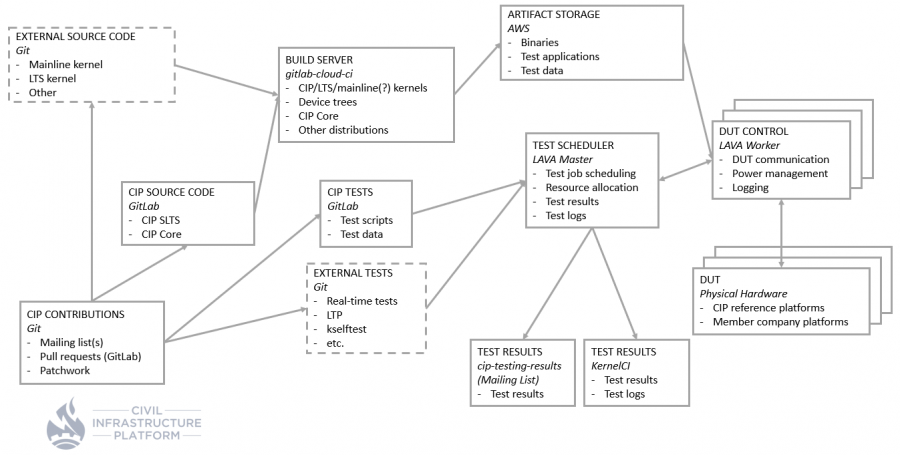
CIP’s centralised testing can run tests without having local access to a platform and it is useful as list of reference platforms grows.
CIP also uses Continuous Integration (CI) testing to automatically test CIP software on CIP hardware.
The block diagram below provides an overview of CIP’s centralised test infrastructure.
LAVA Testing
CIP have set up their own instance of LAVA (Linaro Automated Validation Architecture). LAVA is a continuous integration system for deploying operating systems onto physical and virtual hardware for running tests.
Kernel CI Testing
yet to update
CIP Core Testing
yet to update
CIP Software Updates
CIP aims to provide super long term support and it is important for CIP to have a reference software update mechanism.
Current CIP software update uses Hawkbit server to store the swupdate related files. Client uses SWUpdate and librsync to communicate with Hawkbit.
It supports the following functions
CIP System Monitoring
Yet to update ## Monitoring System Logs ## IPS & IDS Component Logs