CIP Development process (SM-1)
Table of contents
Revision History
Re vis ion No |
Da te |
Change description |
Aut hor |
Reviewed by |
|---|---|---|---|---|
001 |
20 22 -1 2- 20 |
Draft document of CIP development process |
Sai A shr ith |
Dinesh Kumar |
002 |
20 23 -0 3- 28 |
Removed package proposal flowchart harcopy and replaced it with a link |
Sai A shr ith |
Dinesh Kumar |
003 |
20 23 -0 6- 21 |
Add the stages of development process as seperate sections |
Sai A shr ith |
Dinesh Kumar |
Introduction
This document explains the development process used in CIP based on documented requirement checklist for SM-1 requirement in 62443-4-1. Design details such as system’s devices and subsystems connections, exploitable areas and trust boundaries based on SD-1 requirement in 62443-4-1 are also included in this document.
Scope
This document explains the requirements which are clearly confirmed after discussion with Certification body. Some part of documentation is still not available due to need of further discussion with certification body such as configuration management document is SM-1.
SM-1 : Development process
The documentations and details required to fulfill SM-1 requirement in CIP are mentioned below :
Configuration Management with change controls
Configuration management document is available here.It has the details of versioning rules followed for CIP-Core and CIP-kernel.
Audit logging
Audit logging procedures implemented in CIP and the measures taken to counter audit log failures are mentioned in this document.
Requirements definition
The overview of CIP requirements details are mentioned here as project goals.
Some of the project goals of CIP are :-
Super Long Term Support (SLTS) for CIP kernel and CIP Core packages up to 10+ years.
Regular testing of security updates on CIP reference boards.
Provide CIP reference images to CIP users.
Each workgroup to have it’s own focus areas.
CIP members made this document where the functional and non-functional requirements are listed.
CIP Design
CIP-Core re-uses Debian pre-built packages along with CIP-kernel which re-uses mainline kernel. The design and developments process which takes place in mainline kernel is mentioned here. CIP-Core design and development details are mentioned in this CIP-Core Wiki page along with the list of packages being used in the system.
Every package used from Debian in CIP-Core follows the process as mentioned in this illustration before including in the design.

CIP Implementation
CIP-Core implementation details are present in CIP-Core Wiki page and the isar-cip-core repository is actively maintained by the CIP developers. CIP kernel is actively maintained by the CIP developers in CIP Kernel repository.CIP kernel mostly re-uses mainline Linux kernel, so here is the reference with Linux kernel implementation details.
Here is an illustration which explains CIP-Core implementation :
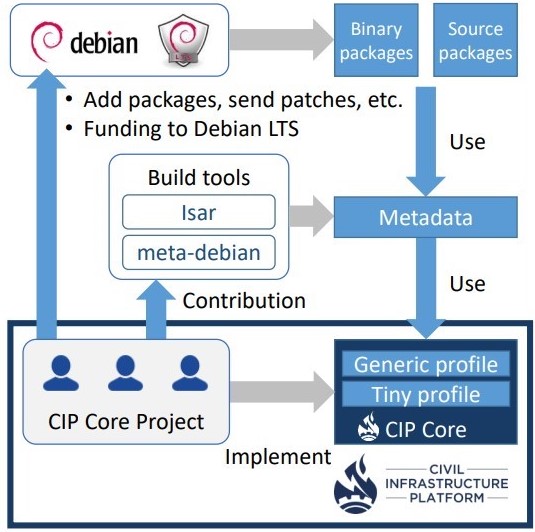
CIP-Core implementation
Testing and validation
The Centralized testing in CIP developers can run tests without having support to a growing list of reference platforms. Here is an illustration of testing overview in CIP.
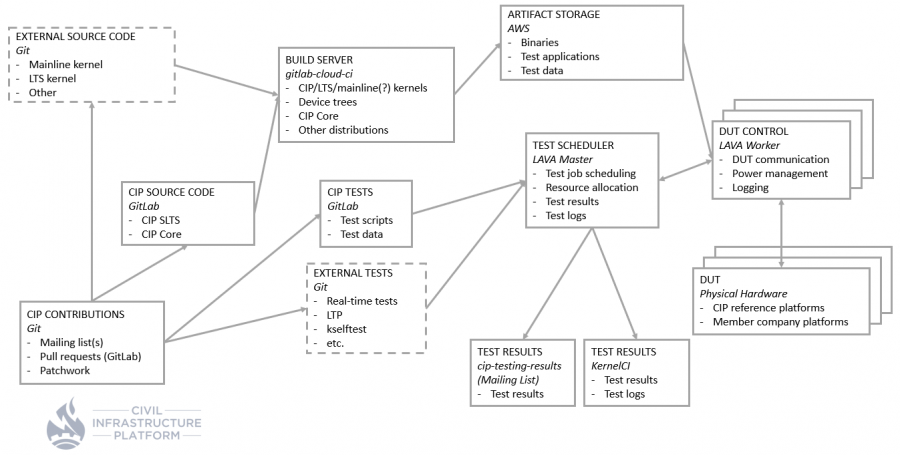 .
.
The continuous integration testing in CIP uses LAVA which helps to automatically test the updated software on CIP hardware. Kernel tests such as **Health and Meltdown checker, LTP tests and some real time tests will run in the LAVA.
In the context of process for repeatable testing, * The detailed process of submitting a custom LAVA job is mentioned here. * The process of running IEC layer tests on the CIP security image is mentioned here.
CIP-Core relies on upstream testing as it re-uses Debian packages without any modifications. The rigorous testing process done by Debian is mentioned at Debian Testing page.Debian also has it’s own CI for testing Debian packages and the results of some packages are available here.